Fablier
An example of a story
(written four-handed with a child)
The simplest way to understand the four-handed story is to watch one being written. Here is the beginning of a story the way an eight-year-old and Numa, Fablier's pen, build it together: the child's first three answers, the chapter born from them two minutes later, then — this is the heart of the game — the three questions Numa leaves for what comes next. The pages below are fictional, written to show the shape of a real story — your child's will belong to them alone.
Saturday, 5 p.m. — the three opening answers
Who is the hero of your story? Give them a name, and one thing they do better than anyone.
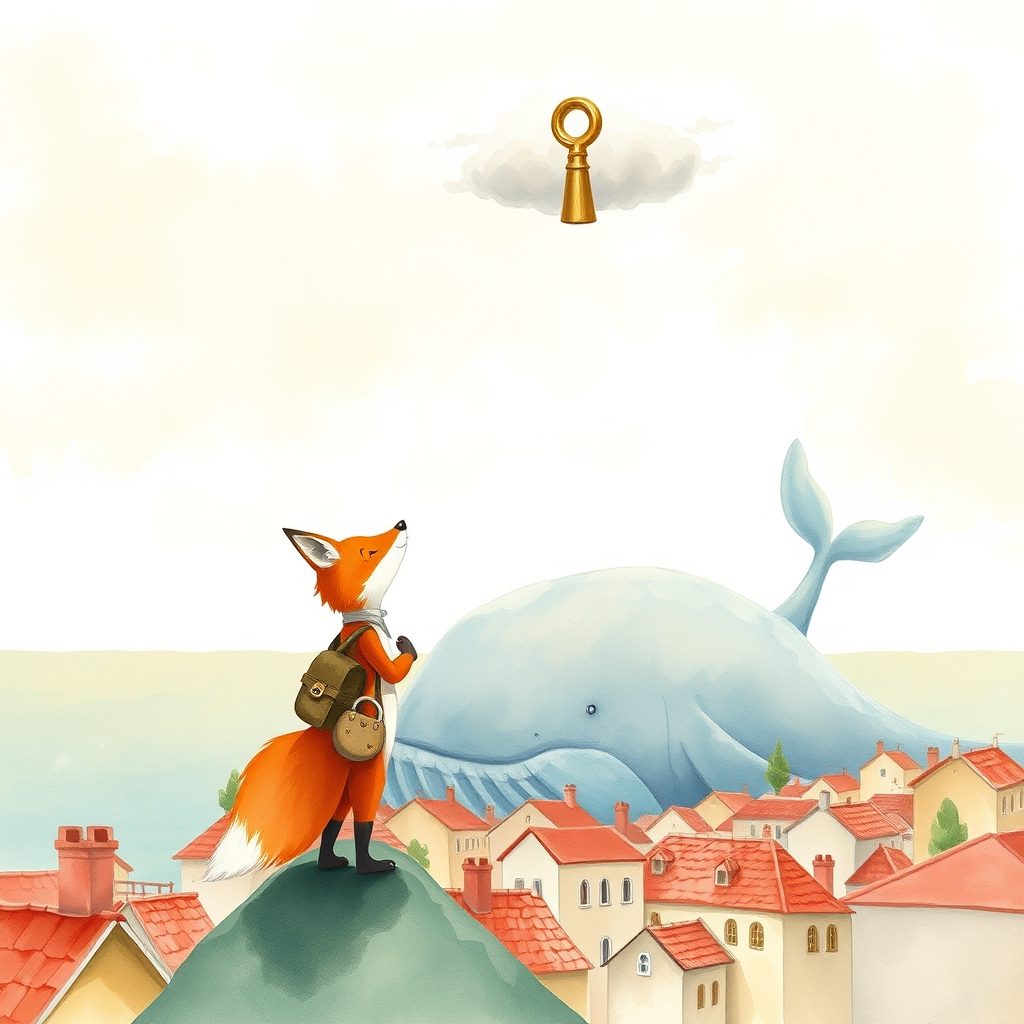
Pino! He's a fox and he can open every lock in the world, even without a key.
Where do they live? Tell me about their world — and what is a little strange about it.
In a city built on the back of a giant whale. When the whale dives, everyone has to close their windows really fast.
What do they want more than anything — or what has just gone wrong for them?
Someone stole the key of the rain and it doesn't rain at all anymore, so the whale is getting too hot.
Two minutes later — the first chapter
The chapter does not spill onto the screen while you watch it being written. When it is done, the screen simply says “It's ready.” and stops there: it is the child who decides when to open it. A book is opened, not endured.
And the story already has a hook
The chapter doesn't end with "the end": it ends with three questions, drawn from the story itself, waiting for the child the next evening. The child decides — and Numa promises to use everything.
1. Who does Pino meet as he climbs toward the lock of the clouds?
2. What does the whale do when it gets really too hot?
3. What clue did the thief of the key leave behind?
And on the nights when nothing comes? Under every question there is “No idea”. It is not a button that writes in the child's place: it is a game. They are asked first what the scene will be — unsettling, moving or strange — they pick a mood, the screen answers “Numa has an idea.” and the seed lands in the page — to keep, to bend or to rub out. The decision stays theirs; only the blank page is gone.
The next day — the child's three answers, word for word
Who does Pino meet as he climbs toward the lock of the clouds?
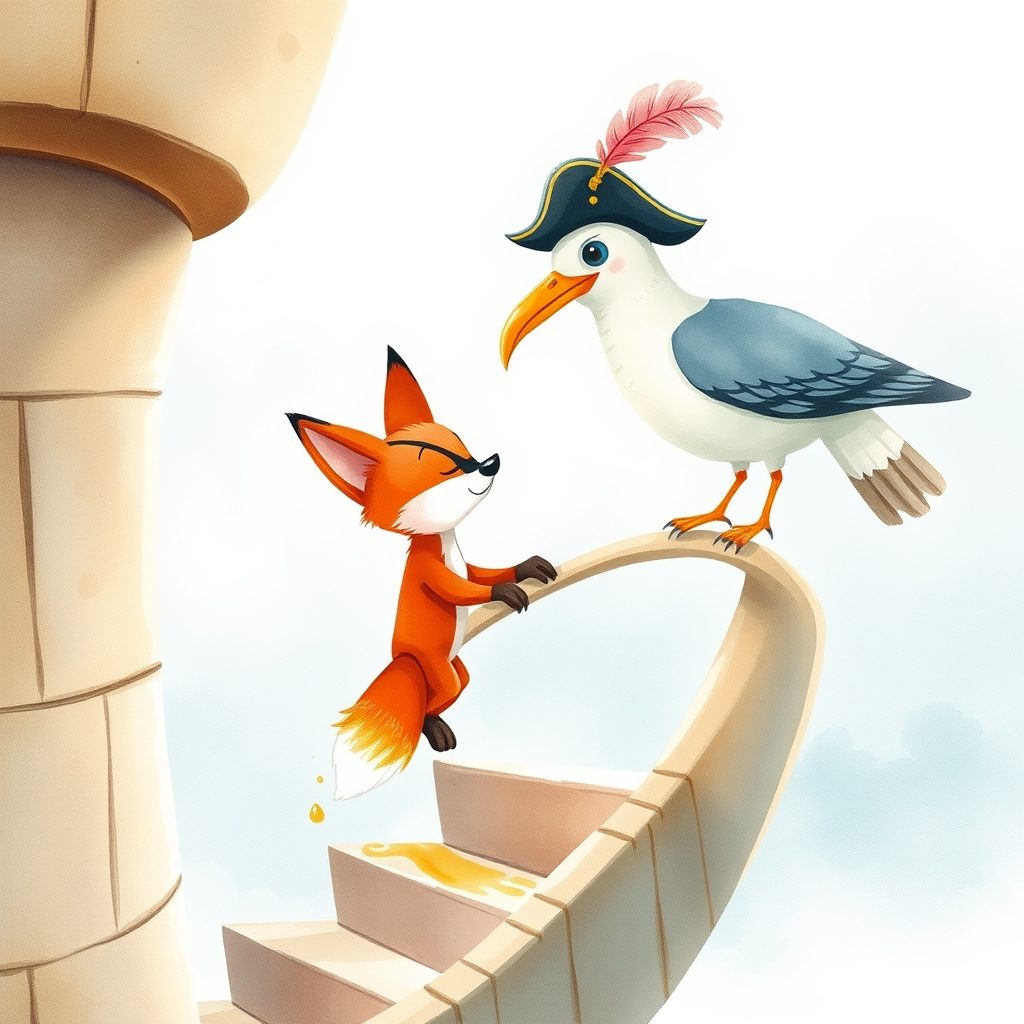
A pirate seagull with an eye patch, her name is Captain Feather.
What does the whale do when it gets really too hot?
It sneezes SO hard that the whole city jumps into the air.
What clue did the thief leave behind?
A smear of cloud jam on the railing of the sky staircase.
And chapter 2 uses it all
And Numa remembers
Captain Feather turned up in chapter 2; she will still be there in chapter 19, eye patch and tricorne and all. Every name, every place, every promise left hanging — the key of the rain, the smear of jam — finds its way into the book's notebook on its own while the chapter is being written. Nothing to file: touch a name in the reader and its card comes up.
And if Numa got something wrong, the author corrects the card themselves — she's a seagull, not a gull — and the correction is final: it will never be written over. The notebook is a memory, not an authority.
And a watercolour for every chapter
The two pictures above are not decorations picked from a stock library: they were painted for these chapters, from the scene Numa had just written. That happens to every chapter of a story — the child answers their three questions, and moments later they find their text and their illustration, set in the world they invented. Nothing to ask for: the characters they made up start existing in colour, including the ones nobody had ever drawn before them.
The style, though, is theirs to pick
Watercolour is the default, not a sentence. Under the cover of their story, a child can switch at any time to comic book, coloured pencil or lifelike — and their latest chapter is repainted on the spot in the new style, the same scene seen differently: the choice shows immediately, otherwise it wouldn't be one. If they'd rather keep their own mental pictures, “no pictures” is there too, and nothing is lost — the day they switch back, the illustrations return.
The tone works the same way, story by story: adventure, epic, funny, spooky, tender. A child who wants muscled knights and one who wants to shiver a little are not writing the same book.
And for which reader? One dial, five notches
The same story is not written the same way for a child still sounding out words and for a confident reader of twelve. In the book's workshop — the settings screen, under the cover — a reading dial runs from “first reader” to “literary”, and moves the length of the sentences, the vocabulary and how demanding the language is, all at once. We ask nobody their age: we ask who it is written for, which is not the same question — and which can be changed the day the child has grown.
What it no longer sets is the length: that is set nowhere. You write one scene at a time, and a scene stops when it has said what it had to say. At the end of each one Numa gives its opinion — “I think this chapter has come to its end” — but the author decides when the chapter closes, and that is when they give it its title, once it is written, the way real writers do. For a child still sounding out words, one scene makes a chapter and it all takes a single tap; for a novel, a chapter breathes.
At the last notch it is no longer a pen for children. “Literary” writes sustained prose, with ellipsis and things left unsaid: the same fablier then serves the adult who wants a novel of their own.
And when you already know where you are going
The bedtime serial works perfectly well without a plan: three questions, a chapter, we'll see tomorrow. But sometimes you already have an idea — a world, a hero, and sometimes the ending. That is the grown-up writing a crime novel who knows who did it, and the child who announces on the very first night that “in the end the dragon becomes kind”.
In that case you say it as you begin, in the “I already have an idea” field. Numa draws the map of the plot from it: five to eight stages the story must pass through, the last one being the announced ending — it does not touch that. Each chapter is then written towards the next stage, never rushing it: a chapter may only bring it one step closer. And when a stage is reached, the book says so, under the chapter's title.
The map is not a rail. It lives in the workshop, next to the tone and the reading dial: you rewrite the stages ahead, remove some, add others, put them in a different order — or ask Numa to replan what comes next from what has actually been written. Only one thing is untouchable: what has already been reached. Those pages are written, they have been read; you do not rewrite a book's past.
And the day they want to write it themselves
There comes a moment — often around eight or nine — when a child no longer wants to dictate: they want to write. That is the moment most tools miss, because they only have one mode. The workshop has three, and they can be switched from one night to the next, inside the same book.
“Numa tells it” is the original mode: three questions, it writes the chapter. “Numa writes it up” replaces the three questions with a single field: the child jots their ideas down — Nael walks into the cave, he finds the axe, the skeleton wakes up — and Numa turns them into prose in the book's voice, inventing nothing: same events, same order, same names. It writes them up; it does not embroider.
And “your page, as it is”: the child writes their chapter, and it enters the book word for word. No correction, no rewriting — it is their page. Numa only reads it, quietly, to hand them the three questions for the next chapter and to paint the illustration of what they have just told. Those pages do not count towards the day's serial: when the child does the work, there is nothing to ration. And they can rework them — their page stays theirs, mistakes included, until they choose to fix them.
And to read it back: page by page
A story that grows a chapter a night ends up being read backwards, newest first — the order it was written in, not the order of the tale. The reader puts the book the right way round: open at chapter one, turn the pages with a thumb or an arrow key, illustrations included, and the app remembers where you stopped. That's the moment a child stops being the author and becomes a reader again — of their own book.
And if they can't read yet: the reader reads aloud
A six-year-old can invent a whole novel long before they can read it back alone. In the reader, “Listen to the story” reads the chapter out loud, sentence by sentence, each one lit up as it is spoken — a finger following the line, which is how reading is learnt. At the end of a chapter the page turns by itself and the tale goes on; one tap stops it. It uses the device's own voice — nothing to install, nothing to download — and it works in the car, or on the nights when nobody is free for the bedtime read.
Now, your child's
That story doesn't exist. Your child's does — it starts with three questions, tonight or next Saturday, and grows one chapter at a time, always from their ideas, never corrected. For the full method, read write a story with your child; if you need a starting point, browse ten story starters.
Open their story
Free today. Three questions, their answers, one chapter a night.